
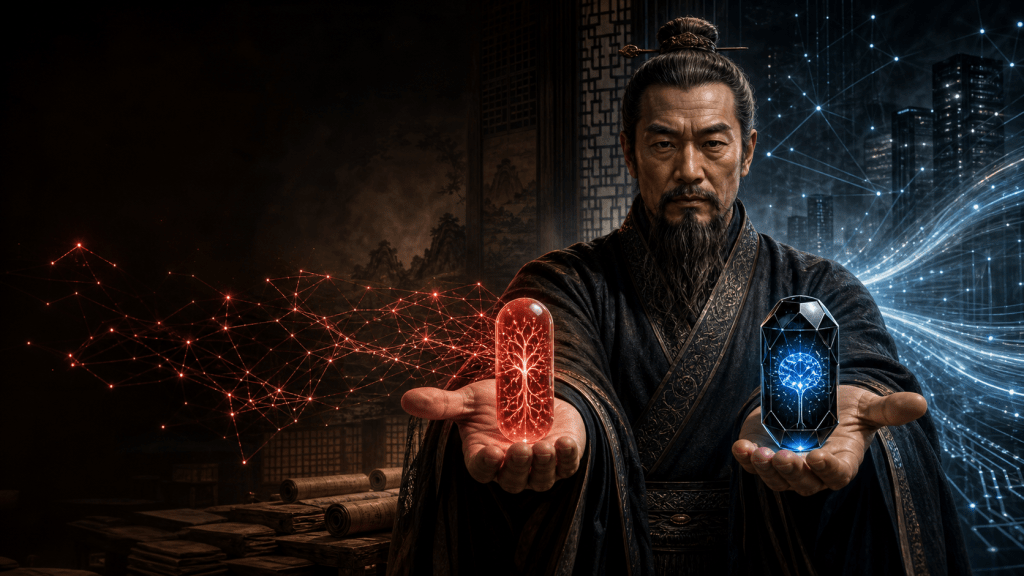
In the fifth century BCE, while the Greek city-states were preparing to bleed one another dry and Rome was little more than an ambitious village on the Tiber, an obscure Chinese strategist committed an idea to strips of bamboo that would outlive every empire that later encountered it.
His name was Sun Tzu—assuming there ever was a single historical Sun Tzu—and The Art of War ultimately rests on one insight, perhaps the most subversive ever written about the nature of power: the supreme art of war is to subdue the enemy without fighting.
For twenty-five centuries, generals, emperors, and business executives have underlined that sentence as though it were merely a metaphor. Only now are we seeing it applied with a precision that Sun Tzu himself might have admired.
The battlefield is no longer a plain crossed by cavalry. It is the mathematical space of weights and tokens inside large language models. And China is winning that war—perhaps it has already won it—without firing a shot.
Over the past several months, for the first time since the beginning of the generative AI era, American supremacy has stopped looking like a given. Across several benchmarks, many real-world applications, and especially on price-to-performance, Chinese models have caught up with or surpassed their Western competitors.
A Methodological Confession
This article took weeks to develop, and the way it came together is part of the story.
To gather evidence and test ideas, I questioned some of the best models available: GPT 5.6 Sol, Perplexity with GPT Terra 5.6, Anthropic’s Fable 5, and Kimi 3.0. GPT and Perplexity gave me predictable answers—surface-level reporting dressed up as analysis. Fable 5 went deeper, but never surprised me.
Then there was Kimi 3.0, a Chinese model. It was in a class of its own.
Its observations were original, its claims were supported by data, and its research went well beyond the obvious. I spent more time talking with Kimi than with any of the others, and it was the model from which I learned the most.
Pause for a moment and consider the irony: the clearest account of China’s rise in artificial intelligence was given to me by a Chinese AI model.
Sun Tzu would have appreciated the elegance.
The Weapon That Doesn’t Look Like One
China’s strategy has an innocuous technical name: open weights.
The idea is to release the parameters of advanced models so that anyone can download, study, modify, and run them. As a strategy for global expansion, it has already been tested. Linux, Chrome, and Android all demonstrated the same principle: if you want your infrastructure to become the global standard, give it away.
No one conquers the world by selling expensive licenses. You conquer it by becoming the water everyone swims in.
But there is a crucial difference this time. Android influences how you navigate a screen. A language model influences what you know about the world.
Chinese models, in order to exist and operate legally, must comply with Chinese law. Full stop. If politically inconvenient facts are excluded from the training data, the model may simply never learn them—and correcting those omissions later is not necessarily straightforward.
For coding and automation, that may not matter. A Python function has no opinion about Tiananmen Square.
The problem is that AI models are becoming the new internet. Most people already accept whatever appears in Google’s AI Overviews without clicking, verifying, or even remembering where the information came from.
This is where the strategy reveals its real brilliance: censorship is not imposed. It is chosen.
Perhaps the most revealing conclusion from my research is that Western users will voluntarily choose restricted access when the restricted model is free. Censorship succeeds through economic gravity. No one has to take anything away from you. The uncensored alternative simply costs money, while the restricted one does not.
Under those conditions, even proprietary Chinese models remain competitive because price alone can be enough to drive adoption.
Sun Tzu expressed the same idea in military terms: the skilled commander subdues an army without battle and captures cities without laying siege.
The Cheapest Soft Power Campaign in History
In the West, the cost of building a frontier AI model looks enormous. But compare it with what the United States has spent over the past thirty or forty years on soft power: Hollywood, elite universities, international broadcasting, cultural exchanges, and the diplomatic programs of successive administrations.
Hundreds of billions of dollars have been invested over generations so that the world would see reality—at least in part—through an American lens.
China has achieved something comparable at a fraction of the cost. It has purchased a permanent place in the daily cognitive lives of potentially half the planet.
This is not propaganda. It is far more effective than propaganda, because almost no one experiences it as such.
No Empire Has a Monopoly on Writing History
Intellectual honesty requires an important qualification: China is not the only country whose models reflect political constraints.
American models also contain deep biases, shaped by the country’s culture wars, lawsuits, regulatory fears, and commercial incentives. Every AI lab encodes the intellectual climate of its own society into its models, then exports the result under the label of neutrality.
Europe, meanwhile, is supposedly caught between the two.
In reality, it is somewhere else entirely. Being “in the middle” would at least require being in the race. Europe, for the most part, is not.
The Moving Wall: Hardware
The standard response is that China will remain stuck without Western chips. That reassurance is beginning to crumble.
China is building its own end-to-end technology stack. It has already demonstrated that it can construct AI data centers with well-parallelized racks and clusters, supported by fiber-optic networking—an area in which Huawei has considerable expertise.
These systems may still be roughly four times less efficient than their Western counterparts. But efficiency is a luxury for countries facing hard resource constraints, and China has an advantage in the most important resource of all: energy.
Western AI projects are colliding with strained power grids, lengthy approval processes, and environmental permits that can take years. Beijing, by contrast, builds.
High-bandwidth memory, or HBM, remains a major bottleneck. China has so far depended heavily on suppliers such as Samsung and Micron. Here too, however, the barrier may be weakening. There is an estimated 50 to 70 percent chance that Huawei’s long-promised domestic production will begin coming online in the months ahead.
Then there is the variable almost no one anticipated—a twist with the flavor of historical irony: Apple.
According to industry rumors, future M-series chips could support as much as 1.5 terabytes of memory, roughly three times what is available today. That would cross an important threshold, making it possible to run sophisticated models—potentially comparable to Anthropic’s Sonnet or OpenAI’s Terra—on a desktop computer.
If that happens, an American company will have placed Chinese open-weight models directly on millions of desks: local, private, free to run, and always available.
This time, the Great Wall may run on a Mac.
The Money—and the Coffin
What breaks on the American side?
Potentially, everything.
The business model of leading U.S. AI labs—premium subscriptions and expensive API access—depends on the assumption that frontier intelligence is scarce and costly. If near-frontier performance becomes free and downloadable, that model either collapses or shrinks dramatically.
An IPO under those conditions becomes far less plausible. Or perhaps the opposite happens: hyperscalers and investors go all in, turning a public offering into an act of geopolitical faith.
Then comes the question no one on Wall Street wants to ask aloud: what happens to the Nasdaq if today’s valuations rest on the belief that America will win the AI race?
Market narratives rarely die because someone disproves them. They die when investors stop believing—and that loss of faith may already have begun.
The most likely response would be a rapid dismantling of U.S. restrictions in the name of competition with China. National security would become the argument for deregulating everything, as quickly as possible, before the perceived window of opportunity closes.
And Europe?
Almost entirely absent, with one major exception: ASML, whose manufacturing technology remains beyond the reach of every would-be competitor, including China. It may be the West’s last true technological fortress, and that is not much consolation.
While two empires race ahead, Brussels writes rules. Its determination to regulate nearly everything in the name of protecting individuals drives another nail into the coffin with each passing day.
Epilogue: Who Gets to Write History?
Throughout recorded history, the winners of wars have written history. Romans, Mongols, colonial empires: first came the sword, then the pen.
Now that order may be reversing.
The side that writes history may be the side that wins the war.
Language models are becoming humanity’s new scribes. They explain the world to billions of people, one answer at a time. And scribes, as every dynasty understood, do not ultimately serve the reader. They serve whoever trained them.
Sun Tzu knew nothing of transformers, attention mechanisms, or gradient descent. But he understood human beings. He knew that the perfect victory does not look like a victory at all. It looks like something that never happened.
There is no battle. No surrender ceremony. No single moment when everyone can say, “That was when everything changed.”
There is only a day when the world wakes up and discovers that it has begun seeing reality through someone else’s eyes.
The best evidence may be this article itself. It was researched, debated, and refined with the help of a Chinese model.
The war is not coming.
It is already here—free, extraordinarily fast, and available as open weights.
 A blog of AI, tech, and mixed stuffs
Leave a comment