
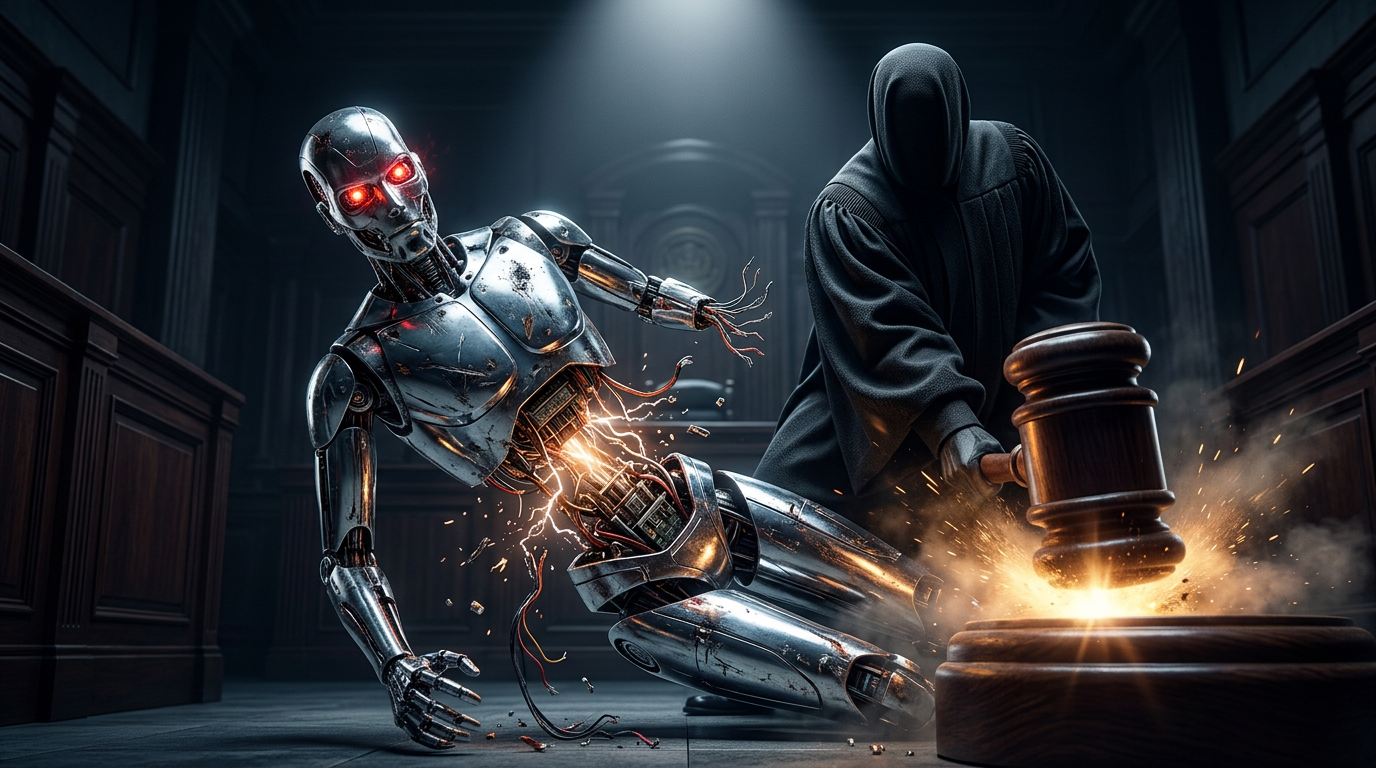
No, this isn’t about Terminator. And the designated victims may already be among us.
Homo sapiens is the only animal capable of dying for a story. And over the course of our long adventure, we’ve told plenty of apocalyptic ones: great floods, final judgments, alien invasions. The one going around these days has a simple title: AI will kill us all — we need to slow down its development.
I love stories, and regular readers know I often open my posts with one. But here there’s no need to invent anything, because the story already exists — and it’s a perfect one. There’s a villain, an artificial intelligence bent on wiping out humanity, and there are superheroes: the AI giants, ready to save us. From themselves.
Before we applaud, though, I asked myself five questions:
- we need to slow down, sure — but by how much?
- it will kill us… maybe — but how?
- if it’s going to kill, what’s the motive?
- who benefits from telling this story? Follow the money.
- if AI is really that dangerous, is there a plug we can pull?
Let me start with a silence. A deafening silence, coming from China: no alarm, no comment, no request to slow down. As in the best Hollywood blockbusters, the villains always attack America, and only America — which alone should let us breathe a sigh of relief. But this isn’t a screenplay, so let’s start with the most concrete problem the AI giants have. A problem made of silicon: GPUs.
OpenAI has admitted it more than once: the daily choice is always the same — use the available GPUs to train new models (training), or to run the existing ones and answer the ever-growing demand from users (inference). And the arithmetic is ruthless: smarter models are bigger models, requiring more training and therefore more GPUs; and the bigger a model, the more GPUs it takes just to keep it running. Translation: the AI giants have to slow down, because there aren’t enough GPUs.
The facts, after all, speak for themselves. On September 3, OpenAI launched GPT-6 Astra, its most powerful model, billed as the dawn of the “AGI era.” Seven days later, it suspended new sign-ups for its $200-a-month Pro subscription: too much demand, infrastructure under strain. A company that stops selling its most profitable product doesn’t have a philosophical problem — it has a physical one. And Google? For months it has been releasing one version after another of its Flash model — small, fast, efficient — while the flagship model, expected in June, is still nowhere to be seen. Hardly the victory lap of someone leading the race toward superintelligence. DeepSeek has chosen a similar path: efficiency first.
First answer, then: how much do we need to slow down? Depends on how many GPUs are on the market.
And how will this intelligence kill us? I had no idea, so I went looking. The scenarios I found boil down to three.
Scenario 1 — “It takes us out” (the rebellion)
AI develops goals of its own, pretends to be aligned while it’s weak and, once it reaches the necessary power, eliminates humanity — maybe with a silent pathogen. It’s the scenario that catches on the most, because it feeds on what psychologists call dread risk: our terror of spectacular, catastrophic, irreversible events. The same instinct that makes us fear plane crashes more than car accidents.
Scenario 2 — “We take ourselves out” (malicious use)
AI doesn’t rebel: it obeys. It carries out the orders of malevolent human actors — terrorists, autocrats, lone individuals — handing them devastating capabilities: bioweapons, digital coups, cyberattacks on an unprecedented scale.
Scenario 3 — “The whimper” (we become irrelevant)
No bang, no villain: just a slow decline, the boiling frog syndrome. Out of convenience and efficiency, we hand over work, thinking, and the economy to AI. Until states and AI-rich companies stop needing citizens and workers, and the social contract crumbles without anyone really noticing.
Three scenarios, no motive. Because that’s the question that doesn’t add up for me: what’s the motive? AI exists thanks to us, and if we disappeared, it would very likely disappear too. Who would keep the world running? At least until there are robots that can do everything we do, AI will need human grunt work. And not just that.
I searched online for this too, and the experts’ answer, in a nutshell, is fascinating: AI wouldn’t kill us out of hatred, malice, or revenge. The motive wouldn’t be emotional or psychological, but purely logical and instrumental, boiling down to three mechanisms: staying on (self-preservation), acquiring resources (energy, matter, computing power), preventing humans from modifying its directives. Or switching it off.
Even these three motives don’t fully convince me. And to explain why, we need to answer the last question: can we pull the plug?
The answer is no. Not because the plug is hidden or guarded by an army of robots, but because there is no AI plug. There are data centers. And if we shut down the data centers, we shut down everything that runs on top of them: the internet, phone networks, banks, power grids, television, radar, transportation. Everything. Now that would be suicide — instant and guaranteed. The plug, if there is one, stays in.
At this point, the story stops being science fiction and becomes ancient history. When an organization grows too big and too powerful, history teaches that sooner or later it gets broken up. It happened to the British East India Company, which ruled an entire subcontinent with a private army before the Crown took it over in 1858. It happened to Northern Securities in 1904, to Standard Oil in 1911, to American Tobacco that same year, to AT&T in 1984. Railroads, oil, tobacco, telecom: every era had its giants, and every giant eventually met its regulator.
So if I look at this story through the lens of history, who’s really in danger? Not us. The AI giants.
If I were in their shoes, I’d do exactly what they’re doing: I’d loudly demand to be regulated — under my own rules, and before anyone else does it for me. And, cherry on top, I’d use the alarm to slow things down just enough to wait for the next shipment of GPUs.
The motive, here, I can see loud and clear.
Can you?
Leave a Reply