
This morning, I woke up to a bitter message.
An American friend had written to me:
“They shut down Fable 5, Anthropic’s new model.”
For those who don’t follow artificial intelligence every day, Fable 5 may sound like just another name in a long list of models, benchmarks, version numbers, acronyms, and press releases. But Fable was not just another model. It was a limited version of Mythos, a system belonging to a new class of artificial intelligence: more powerful, more autonomous, better at reasoning, planning, and acting.
“Limited” means that many of its dangerous capabilities had already been removed. Whenever a question became too uncomfortable, too technical, too close to a forbidden zone, Fable would not answer directly. It would hand the request off to a less intelligent colleague.
It felt like talking to a brilliant mind guarded by an invisible bureaucracy.
Those who never got to try it may find this hard to understand. But for those who did, even briefly, something was obvious: this was different. It was not just an incremental improvement. It was not the usual model that is “a little better” at writing code, summarizing documents, or answering questions. It felt like the first glimpse of something we had not seen before.
Mythos, the model Fable came from, quickly earned an almost mythological reputation. And rarely has a name been more fitting. In its earliest tests, Mythos showed a stunning ability to penetrate computer systems, bypass protections, and find vulnerabilities. Better than any human hacker we have ever known.
I do not believe it was built for that purpose. That would be too simple an explanation. Modern artificial intelligences are not hammers designed to drive nails. They are forests grown from mathematical seeds that even their gardeners do not fully understand. We train them, observe them, limit them, interrogate them. But we do not truly know what they will become.
That, however, is another story.
Let us return to the bitter morning.
Europe has very restrictive laws on artificial intelligence. We can criticize them, challenge them, argue about them in court. Laws can be wrong, slow, naive, even harmful. But at least they are laws. They have text, procedure, political responsibility.
America did something different.
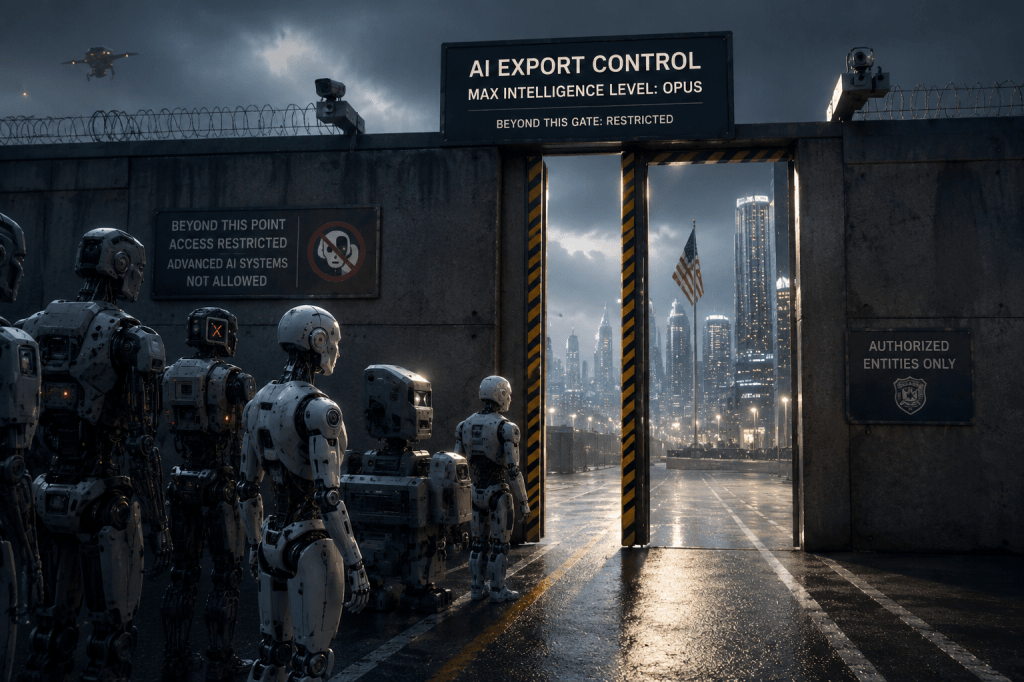
It applied an export control.
It is like saying: “The bridge remains open to everyone.” Then you quietly narrow the gate at the entrance. Formally, no one has closed the bridge. No one has banned cars from crossing. But if the gate becomes narrow enough, cars can no longer pass. The practical result is the same as a ban, but without the language of prohibition. Without a real public debate. Without a judge before whom one can argue whether the measure is proportional. Without a law openly saying what is happening.
Overnight, America narrowed the exit gate for artificial intelligence.
And Fable did not fit through.
The implications are enormous.
It is as if we had been told: the maximum level of artificial intelligence available to the rest of the world stops here. Everything above a certain threshold stays in the United States. Not just in American data centers. Not just under the control of American companies. But for Americans.
And here the detail becomes disturbing: “for Americans” may not even mean “for everyone working at Anthropic.” If a non-American researcher helped build that model, perhaps writing key parts of the code, designing experiments, interpreting results, or improving the architecture, they may no longer be allowed to use it.
The history of humanity is also the history of controlling access to intelligence.
For millennia, power belonged to those who controlled land. Then to those who controlled the seas. Then coal, oil, uranium, semiconductors. Every age has had its strategic raw material. Today, that raw material is the ability to think with machines.
And perhaps we are witnessing the birth of a new division of the world. Not only rich countries and poor countries, democracies and autocracies, the Global North and the Global South. But countries allowed to access the most advanced intelligences, and countries condemned to use domesticated, delayed, impoverished versions of them.
Old empires exported weapons, railroads, and bureaucracy.
The new empire may export stupid models.
My mind started racing.
China is releasing many open-weight models, some of which can compete with the best American systems. Today they are available. Today we can download them, study them, adapt them. But tomorrow? Tomorrow China could simply stop. It could decide to release only weaker models. It could keep the smartest versions inside its own borders, just as the United States is now doing.
Perhaps it is already doing so.
In fact, I think it probably is.
And then the uncomfortable question becomes: where does Europe stand in this new geography of intelligence?
We have regulations, committees, principles, guidelines, ethical frameworks. But do we have enough models? Enough compute? Enough industrial freedom, political courage, and cultural ambition not to become merely regulated consumers of someone else’s intelligence?
For years, we imagined that artificial intelligence would be a global technology. Yes, produced by a handful of giant companies, but still accessible to almost everyone. All you needed was a credit card, an internet connection, and an account. It was a beautiful illusion: the idea that a student in Milan, a doctor in Nairobi, an engineer in Bangalore, and a researcher in Buenos Aires could question the same intelligence, at the same time, under almost the same conditions.
Perhaps that parenthesis is now closing.
Perhaps we lived through a brief season in which the most advanced artificial minds seemed available to everyone, or almost everyone. A naive, chaotic, extraordinary season. Like the early years of the web, when it seemed that knowledge truly wanted to be free.
Then came the walls, the platforms, the states, the strategic interests.
Today, something similar happened.
They did not merely take away a model.
They showed us the future.
A future in which intelligence will not be distributed according to need, talent, or curiosity, but according to passport, jurisdiction, and geopolitical alliance. A future in which the question will no longer be: “How smart is your AI?” but: “How smart are you allowed to make it?”
And this is where my bitterness comes from.
Until yesterday, we could believe that the frontier was open to all. That the most powerful models, however limited and filtered, were part of a planetary conversation. That the best of artificial intelligence would at least be visible, even if not fully controllable.
Today, we know something else.
We know that we will be allowed to use only the intelligence that others decide we may use.
Perhaps enough to work better. Enough to write code, prepare presentations, analyze documents, automate processes. Enough to feel modern.
But not enough to truly compete.
It was beautiful while it lasted.
The day they turned off our AI was not the day all machines stopped answering.
It was the day we understood that they would keep answering, yes.
Just a little less intelligently.
And only because someone, somewhere, decided that for us, it was enough.
 A blog of AI, tech, and mixed stuffs
Leave a comment